 Reviews

 Proudly American

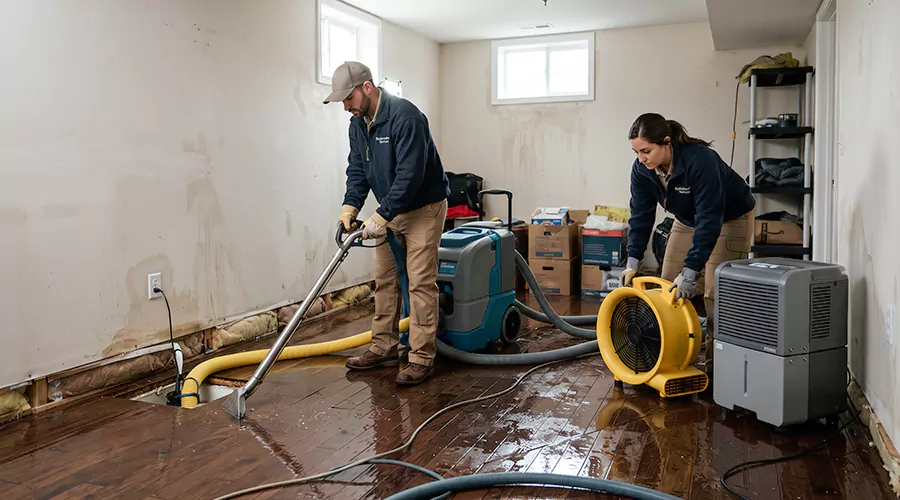
Water mitigation cost typically ranges from about $250 to $2,000 for the immediate stabilization phase in 2026, while larger extraction and drying projects can run several thousand dollars. A broader residential water-damage project commonly costs $2,000 to $6,000 once drying or later repairs are included.
The final price depends on how much water entered the property and how far it spread. Contamination also matters because sewage or outside floodwater requires more removal than a clean supply-line leak.
Mitigation happens before reconstruction. Its purpose is to stop additional damage through extraction and controlled drying rather than rebuild the finished property.
What Is Included in Water Mitigation Cost?
A typical mitigation bill covers the work needed to stabilize a wet property before permanent repairs begin. That usually includes an initial assessment and standing-water extraction. Structural drying can follow when drywall or flooring remains wet. Material removal may also be included when damaged items cannot remain safely in place.
Common charges can include:
- Initial moisture assessment
- Water extraction
- Air movers
- Dehumidifiers
- Daily equipment monitoring
- Moisture measurements
- Removal of damaged carpet padding
- Limited drywall removal
- Cleaning after contaminated water
- Disposal of unsalvageable material
Mitigation does not always include installing new drywall or replacing flooring. Those tasks are usually part of the later restoration stage.
This distinction matters when comparing estimates. A lower quote may cover only extraction while another may include three or four days of drying equipment.
How Much Does Water Mitigation Cost by Project Size?
Small contained losses can stay below $2,000 while larger projects can move well beyond that amount. Current 2026 pricing places many overall water-damage projects between $2,000 and $6,000. Severe losses can exceed $15,000 when several rooms or building layers become saturated.
A useful planning range is:
| Project Scope | Typical 2026 Cost |
|---|---|
| Small contained clean-water loss | $250 to $1,000 |
| One-room mitigation | $1,000 to $3,000 |
| Multiple wet materials | $1,500 to $5,000 |
| Several affected rooms | $3,000 to $7,000 |
| Major contaminated loss | $5,000 to $15,000+ |
These figures are planning ranges rather than fixed prices. A small bathroom can cost more than a larger open room if water has entered wall cavities.
Square footage also doesn't tell the full story. A thin layer of clean water across tile can be easier to manage than a smaller amount trapped beneath hardwood.
How Does the Water Category Affect the Price?
The water source has a major effect on price because contamination changes how materials are handled. Clean water from a sanitary source requires the least complex response. Gray water needs more caution. Black water commonly requires removal of porous materials that might otherwise have been dried.
Current 2026 extraction and drying rates provide a useful comparison:
| Water Category | Typical Cost Per Sq. Ft. |
|---|---|
| Category 1 clean water | $4 to $6 |
| Category 2 gray water | $6 to $9 |
| Category 3 black water | $9 to $12 |
These figures apply to extraction and drying rather than complete reconstruction.
Category 3 water can come from sewage backups or groundwater intrusion. Porous materials exposed to this level of contamination are much more likely to require removal.
Category 3 water mitigation therefore costs more because the job involves contamination control in addition to moisture removal.
How Does the Water Damage Class Affect Cost?
Water class describes how much of the property became wet rather than how contaminated the water is. A Class 1 loss stays relatively contained. Class 4 involves severe saturation and can affect dense materials that take much longer to dry.
Current 2026 restoration ranges by class look like this:
| Water Damage Class | Typical 2026 Cost |
|---|---|
| Class 1 | $150 to $500 |
| Class 2 | $1,500 to $5,000 |
| Class 3 | $5,000 to $15,000 |
| Class 4 | $15,000 to $100,000 |
These figures include broader restoration costs and show how quickly the budget can grow when saturation spreads through more of the building.
Class 2 can involve significant water in one room. Class 3 reaches larger parts of the room including walls or subflooring.
Class 4 describes major saturation that can require extended drying. Dense wood or masonry can hold moisture much longer than a painted wall surface.
How Much Does Water Extraction Cost?
Water extraction and drying generally cost about $4 to $12 per square foot in 2026. The lower end applies to clean water while contaminated water sits at the higher end. Equipment needs and access can move the final amount within those ranges.
For a 500-square-foot affected area, that could mean:
- Clean water at $4 to $6 per sq. ft. equals about $2,000 to $3,000.
- Gray water at $6 to $9 per sq. ft. equals about $3,000 to $4,500.
- Black water at $9 to $12 per sq. ft. equals about $4,500 to $6,000.
The amount of water still matters. A damp 500-square-foot area doesn't require the same work as 500 square feet under several inches of standing water.
Water damage cleanup cost can also rise when extraction reveals moisture under flooring that wasn't visible before the first pass.
Why Does Drying Time Increase the Cost?
Drying time raises the bill because air movers and dehumidifiers often stay in the property for several days. Larger losses need more equipment. Dense materials can also hold moisture longer than exposed drywall, which increases monitoring time before the structure reaches an acceptable dry condition.
Several factors extend drying:
- Saturated hardwood
- Wet subflooring
- Plaster walls
- Insulation inside cavities
- High indoor humidity
- Limited airflow
- Basement conditions
- Large affected areas
Most smaller water-damage incidents can be resolved over several days. Larger contaminated losses may take weeks when reconstruction is included.
Water mitigation moisture readings help determine whether equipment should stay in place. Comparing affected materials with dry reference areas gives a better picture than simply deciding that the room feels dry.
Removing drying equipment too early can leave moisture inside the structure. Leaving equipment longer than necessary can add avoidable cost.
How Much Does Basement Water Mitigation Cost?
Basement losses often cost more because water can spread across a large floor area while also reaching finished walls. A 500-square-foot basement can cost about $2,000 to $3,000 for clean-water cleanup. Gray water can reach $3,000 to $4,500 while black water can reach $4,500 to $6,000 or more.
Basement water mitigation becomes more expensive when the space contains:
- Finished drywall
- Carpet and padding
- Stored belongings
- Wood framing
- Cabinets
- Electrical equipment
- Insulation
An unfinished concrete basement often has fewer materials to remove. A finished basement can require significant tear-out even when the water depth was modest.
Groundwater or sewage exposure can increase the scope again because contamination changes what can safely remain.
What Other Factors Can Increase the Mitigation Bill?
The most expensive jobs usually involve more than standing water. Hidden moisture and difficult access can increase labor. After-hours emergencies can also carry additional charges. The amount of damaged material removed before drying begins can make a major difference in the final invoice.
Common price factors include:
- Water depth
- Total affected square footage
- Number of affected rooms
- Water contamination
- Drying duration
- Amount of extraction equipment
- Wall or ceiling access
- Carpet removal
- Insulation removal
- Disposal fees
- After-hours response
- Difficult crawl-space access
Emergency water mitigation can cost more when the response happens overnight or during a holiday. However, delaying a major leak can allow more materials to become wet.
This creates an important tradeoff. Paying for an emergency response may be less expensive than allowing water to spread into an adjoining room overnight.
What Is the Difference Between Mitigation and Restoration Cost?
Mitigation pays for stopping additional damage while restoration pays for rebuilding what was damaged. Mitigation usually comes first and can include extraction or drying. Restoration happens afterward and may include new drywall or flooring. Mixing both phases into one number can make cost comparisons misleading.
Here is the difference:
| Cost Category | Mitigation | Restoration |
|---|---|---|
| Water extraction | Usually included | Usually completed already |
| Structural drying | Included | Usually completed |
| Moisture monitoring | Included | Limited |
| Damaged material removal | Sometimes included | May follow |
| New drywall | Usually not included | Common |
| Flooring replacement | Usually not included | Common |
| Painting | Usually not included | Common |
| Final reconstruction | No | Yes |
Current 2026 data places mitigation at an average near $600 in one national comparison while remediation averages about $4,000.
Water mitigation and restoration can still appear on the same overall project. The difference is the purpose of each phase.
Water remediation cost becomes higher because it can include returning damaged areas to their previous finished condition.
How Does Water Mitigation Compare With Full Restoration?
The mitigation portion can be a relatively small part of the final bill when extensive rebuilding follows. Current 2026 data places overall water-damage restoration between about $450 and $16,000 for many projects. Another national source puts the typical range at $2,000 to $6,000.
A simple example shows why:
- A pipe bursts and wets one bedroom.
- Standing water is extracted.
- Carpet padding is removed.
- Drying equipment runs for several days.
- The structure reaches normal moisture levels.
- New flooring is installed afterward.
Steps two through five belong mainly to mitigation. The final flooring work belongs to restoration.
Water damage restoration cost therefore shouldn't be compared directly with an extraction-only estimate. The scopes are different.
Can You Estimate the Cost Yourself?
You can create a starting budget by measuring the affected floor area and identifying the likely water category. Multiply the area by the current extraction range for that category. Then consider whether walls or flooring are also saturated because these conditions can increase drying or removal costs.
Use this simple process:
- Measure the wet area's length.
- Measure its width.
- Multiply the two numbers.
- Identify whether the source is clean or contaminated.
- Use the matching $4 to $12 per-square-foot extraction range.
- Add extra room for damaged-material removal.
For example, a 20-foot by 20-foot room contains 400 square feet.
Clean-water extraction at $4 to $6 per square foot would create a starting range of about $1,600 to $2,400. Black-water work at $9 to $12 per square foot would put the same area around $3,600 to $4,800.
This calculation doesn't include later reconstruction. It is only a useful way to understand the likely mitigation scale.
What Warning Signs Usually Mean the Cost Will Be Higher?
Costs rise when water has moved beyond exposed surfaces and entered building cavities. Several wet rooms also require more equipment. Contaminated water creates another major increase because some porous materials can no longer remain. These conditions usually matter more than the original size of the visible puddle.
Watch for these signs:
- Water has entered several rooms.
- Drywall is wet above the baseboard.
- Carpet padding is saturated.
- Hardwood begins cupping.
- Water reaches a wall cavity.
- Ceiling materials become wet.
- Insulation is saturated.
- Sewage entered the property.
- Water remained overnight.
- The source continued leaking for hours.
- Moisture is present on multiple floors.
- Drying takes longer than expected.
A one-inch puddle can still produce an expensive project when it spreads under flooring across several rooms.
The counterintuitive point is that water depth alone doesn't determine the bill. Where the water traveled often matters more.
When Should You Call a Professional?
Professional help is appropriate when the amount of water exceeds what household equipment can remove or when contamination is present. Electrical exposure is another clear trigger. Hidden moisture inside walls can also make professional measurement useful because surface appearance doesn't reveal the full affected area.
Consider professional assessment when:
- Several rooms are affected.
- Standing water is deep.
- Water reached electrical components.
- Sewage is present.
- Groundwater entered the home.
- Ceiling materials are saturated.
- Hardwood flooring is badly cupped.
- Insulation became wet.
- Wall cavities are affected.
- The source cannot be stopped.
- Moisture remains after active drying.
- Mold has already appeared.
A larger loss can require commercial extraction equipment and multiple dehumidifiers. Moisture monitoring can also show whether drying is progressing as expected.
Professional assessment is especially useful when the estimate includes both mitigation and reconstruction. Ask for those phases to be separated so each charge is easier to understand.
How Can You Keep Future Water Mitigation Costs Lower?
The best way to reduce future costs is to limit how much water spreads before extraction begins. Fast shutoff and leak detection can keep a small plumbing problem from reaching several rooms. Routine maintenance also reduces the chance that a slow leak stays hidden until building materials become saturated.
Use these preventive steps:
- Learn where the main water shutoff is.
- Inspect supply hoses several times a year.
- Check under sinks every month.
- Inspect the water heater for moisture.
- Test the sump pump before storm season.
- Install leak alarms in high-risk areas.
- Check ceilings after major rain.
- Investigate musty odors early.
- Repair small plumbing leaks promptly.
- Keep gutters draining away from the building.
A basic leak alarm can alert you before water reaches another room. That small warning can reduce the area requiring extraction.
The largest savings usually come from reducing the scope of the loss rather than finding a cheaper drying rate after widespread damage has already occurred.
Conclusion
Water mitigation cost can range from a few hundred dollars for a small contained loss to several thousand dollars when water reaches multiple materials. Contamination and drying time have the greatest effect on the final bill. Mitigation should also be priced separately from later reconstruction. If water enters walls or several rooms, professional assessment can clarify the scope. This week, locate your main water shutoff and test any leak alarms in the home.
Frequently Asked Questions
Does insurance cover water mitigation?
Homeowners insurance may cover mitigation when water damage comes from a covered sudden event. Flooding from outside the home usually requires separate flood coverage.
How long does water mitigation usually take?
Many residential drying projects take about three to five days. Heavy saturation can require more time before moisture levels return to an acceptable range.
Is water extraction included in mitigation?
Yes. Extraction is usually one of the first mitigation steps because removing bulk water reduces the amount that building materials continue absorbing.
Does mitigation include replacing drywall?
Damaged drywall may be removed during mitigation when it prevents proper drying. Installing new drywall is normally part of the later restoration phase.
Why is black water more expensive to mitigate?
Black water requires more contamination control and material removal. Current extraction rates are about $9 to $12 per square foot compared with $4 to $6 for clean water.
Can a small leak still lead to a large mitigation bill?
Yes. A small leak can become expensive when it runs unnoticed and spreads beneath flooring or into wall cavities before anyone finds it.